SSI vs. SSDI 2026: Eligibility & Average Payouts Comparison
Understanding SSI vs. SSDI: A 2026 Comparison of Eligibility and Average Monthly Payouts for Disability Benefits is vital for individuals with disabilities navigating the complex landscape of federal assistance programs, as each program serves different financial and work history profiles.
Navigating the world of disability benefits in the United States can often feel like deciphering a complex puzzle, especially when confronted with acronyms like SSI and SSDI. For individuals facing disabilities, understanding the distinctions between Supplemental Security Income (SSI) and Social Security Disability Insurance (SSDI) is not just important, it’s absolutely critical for securing necessary financial support. This comprehensive guide aims to clarify Understanding SSI vs. SSDI: A 2026 Comparison of Eligibility and Average Monthly Payouts for Disability Benefits, providing insights into their unique requirements, application processes, and what you can expect in terms of financial assistance.
Defining SSI: Supplemental Security Income in 2026
Supplemental Security Income (SSI) is a federal program designed to provide financial assistance to disabled adults and children who have limited income and resources. Unlike other Social Security programs, eligibility for SSI is not based on prior work history or contributions to Social Security taxes. Instead, it is a needs-based program, meaning an individual’s financial situation is the primary determinant for receiving benefits.
In 2026, the core principles of SSI remain steadfast, focusing on providing a safety net for the most vulnerable. This program is administered by the Social Security Administration (SSA), but it is funded by general tax revenues, not by Social Security taxes. This distinction is crucial for understanding its purpose and how it operates within the broader framework of federal assistance.
Who Qualifies for SSI?
Qualifying for SSI involves meeting specific criteria related to age, disability, income, and resources. The SSA defines disability for adults as the inability to engage in any substantial gainful activity due to a medically determinable physical or mental impairment that is expected to result in death, or has lasted or is expected to last for a continuous period of not less than 12 months. For children, the disability definition is slightly different, focusing on marked and severe functional limitations.
- Age Requirement: Be 65 or older, or blind, or disabled.
- Income Limits: Your countable income must be below a certain threshold, which varies by state and living situation.
- Resource Limits: Your countable resources (assets) must not exceed $2,000 for an individual or $3,000 for a couple.
- Residency: Be a U.S. citizen or eligible non-citizen residing in one of the 50 states, the District of Columbia, or the Northern Mariana Islands.
The income and resource limits are subject to change annually, reflecting cost-of-living adjustments and other legislative updates. It is always advisable to check the most current figures directly with the SSA or a qualified benefits counselor to ensure accurate information for 2026.
In summary, SSI serves as a critical financial lifeline for disabled individuals, including children, and seniors with very limited financial means. Its needs-based structure distinguishes it from other Social Security programs, making it a crucial component of the social safety net.
Understanding SSDI: Social Security Disability Insurance in 2026
Social Security Disability Insurance (SSDI) is a federal insurance program that pays benefits to you and certain members of your family if you are “insured,” meaning you have worked long enough and paid Social Security taxes. Unlike SSI, SSDI is not based on financial need but rather on your work history and contributions to the Social Security system through payroll taxes.
When you work and pay Social Security taxes, a portion of those taxes goes into the Social Security trust fund. This fund is then used to pay benefits to retirees, survivors, and disabled workers. In 2026, the fundamental structure of SSDI continues to rely on this insurance model, providing a form of earned benefit for those who become disabled and can no longer work.
Work Credits and Eligibility for SSDI
To qualify for SSDI, you must have accumulated a certain number of “work credits.” These credits are earned through your employment and by paying Social Security taxes. The number of credits required depends on your age when your disability began. Generally, you need 40 credits, with 20 of them earned in the last 10 years ending with the year your disability began. However, younger workers may qualify with fewer credits.
- Disability Definition: The SSA uses the same strict definition of disability for SSDI as it does for SSI.
- Work History: You must have worked a sufficient amount of time and paid Social Security taxes.
- Earnings Record: Your past earnings record determines the amount of your monthly benefit.
- Dependents: Certain family members, such as spouses and minor children, may also be eligible for benefits based on your work record.
The work credit system ensures that those who have contributed to the system throughout their working lives are protected in the event of a disabling condition. This earned benefit model is a key differentiator from the needs-based SSI program, highlighting the insurance aspect of SSDI.
In essence, SSDI provides a vital safety net for individuals who have a substantial work history and have contributed to the Social Security system. It is a testament to the principle of social insurance, offering financial stability when a disabling condition prevents continued employment.
Key Differences: SSI vs. SSDI Eligibility in 2026
While both SSI and SSDI provide disability benefits, their eligibility criteria are fundamentally different, reflecting their distinct purposes. Understanding these differences is paramount for anyone considering applying for either program. The year 2026 brings no major shifts to these foundational differences, but it is always wise to stay updated on any potential legislative adjustments.
The most significant divergence lies in the basis of qualification: one is an insurance program, and the other is a welfare program. This distinction impacts not only who qualifies but also the nature and amount of benefits received.
Financial Need vs. Work History
The core difference revolves around financial standing and work contributions. SSI is strictly needs-based. This means that if your income or resources exceed certain limits, you will not qualify, regardless of your disability. The SSA carefully scrutinizes your assets and earnings to determine eligibility, aiming to support those with the most limited financial capacity.
SSDI, conversely, is earned through work. Your financial need is not a factor; what matters is whether you have paid enough into the Social Security system through taxes. This makes SSDI more akin to a long-term disability insurance policy that you’ve been contributing to throughout your career.
Another crucial difference lies in the family benefits. With SSDI, certain family members, such as spouses and minor children, may be eligible for benefits based on the disabled worker’s record. This is not the case with SSI, which is designed to provide benefits solely to the eligible individual.
In summary, SSI eligibility hinges on limited income and resources, providing a safety net for those with significant financial constraints. SSDI eligibility, however, is contingent on a substantial work history and contributions to Social Security, reflecting an earned benefit model. Knowing which program aligns with your circumstances is the first step in seeking disability assistance.
Average Monthly Payouts: SSI vs. SSDI in 2026
The amount of disability benefits an individual receives from either SSI or SSDI can vary significantly. These variations are directly tied to the distinct eligibility requirements and funding mechanisms of each program. For 2026, while specific figures are subject to annual cost-of-living adjustments (COLAs), the general principles governing payout calculations remain consistent.
Understanding how these payouts are determined is crucial for financial planning. It’s not a one-size-fits-all scenario, and personal circumstances play a large role in the final benefit amount.
Calculating Your Potential Benefits
For SSI, the maximum federal benefit amount is set annually by Congress and is uniform across most states, though some states may supplement this amount. In 2026, the maximum federal benefit is expected to reflect inflationary adjustments. However, your actual payment can be reduced based on any “countable income” you receive, such as wages, other benefits, or even in-kind support and maintenance. This means that the average monthly payout for SSI recipients is often less than the maximum federal benefit.
For SSDI, the benefit amount is highly individualized. It is calculated based on your average lifetime earnings before your disability began. The more you earned and contributed to Social Security taxes, the higher your potential monthly benefit will be. There is no set maximum, but rather a range determined by the individual’s specific earnings record. The average SSDI benefit is typically higher than the average SSI benefit, reflecting the program’s insurance nature.
It is important to remember that these are average figures. Your personal benefit amount will depend on your unique situation. The SSA provides tools and resources to help estimate potential benefits, and it is always advisable to consult with them directly for the most accurate projections for 2026.
In conclusion, SSI payouts are needs-based and subject to income and resource limitations, often resulting in a lower, but consistent, benefit for those with the greatest financial need. SSDI payouts, conversely, are earning-based, potentially offering higher benefits that reflect an individual’s past contributions to the Social Security system. Both programs aim to provide essential financial support, though through different mechanisms.
The Application Process for SSI and SSDI in 2026
Applying for disability benefits, whether SSI or SSDI, can be a lengthy and often challenging process. While the core steps remain consistent for 2026, applicants should be prepared for detailed documentation requirements and potential waiting periods. The Social Security Administration (SSA) oversees both programs, so many initial application procedures are similar, despite the differing eligibility criteria.
Patience and thorough preparation are key to navigating the application process successfully. Understanding each stage can help alleviate some of the stress involved.
Steps to Take and What to Expect
The application process generally begins with an initial application, which can be submitted online, by phone, or in person at a local SSA office. For both SSI and SSDI, you will need to provide extensive medical evidence to prove your disability. This includes medical records, doctor’s reports, test results, and any other documentation that supports your claim of being unable to work. The SSA will also require detailed information about your work history (for SSDI) and your financial situation (for SSI).
- Gather Documentation: Collect all relevant medical records, work history, and financial information before applying.
- Complete Application: Fill out the application thoroughly and accurately, providing all requested details.
- Disability Determination: Your application will be reviewed by Disability Determination Services (DDS), a state agency that makes medical disability decisions for the SSA.
- Potential Appeals: If your initial application is denied, you have the right to appeal the decision, which can involve several stages, including reconsideration, a hearing by an Administrative Law Judge, and further appeals.
The waiting period for a decision can vary, often taking several months. If your application is approved, benefits typically begin a few months after the established onset of your disability (for SSDI) or from the date of your application (for SSI).
In conclusion, while the specific documentation requirements for SSI and SSDI differ based on financial need versus work history, the overarching application process is managed by the SSA. A meticulous approach to gathering evidence and understanding the various stages, including potential appeals, is essential for a successful outcome in 2026.
Impact of Other Benefits and Resources on SSI/SSDI
When considering SSI and SSDI, it is vital to understand how other forms of income, benefits, and resources can affect your eligibility and payment amounts. This is particularly true for SSI, which is needs-based, but can also have implications for SSDI under certain circumstances. Being aware of these interactions can prevent unexpected reductions or disqualifications.
The interplay between various assistance programs can be complex, and a clear understanding is necessary to maximize your benefits and avoid pitfalls.
Navigating Income and Resource Limits
For SSI recipients, almost any income or resource can affect your benefit amount. This includes wages, pensions, unemployment benefits, and even in-kind support (such as free rent or food). The SSA has specific rules for how different types of income are counted and how they reduce your SSI payment. It’s not a dollar-for-dollar reduction, as some income is excluded, but a significant portion will be considered.
For SSDI, your benefit amount is generally not affected by other unearned income or resources. However, if you are working while receiving SSDI, there are specific limits on how much you can earn before your benefits are impacted. This is known as Substantial Gainful Activity (SGA) and is a key factor in determining if you are still considered disabled for SSDI purposes. In 2026, the SGA limit will likely see an adjustment.
Furthermore, individuals may be eligible for both SSI and SSDI, a situation known as “concurrent benefits.” This typically occurs when an individual’s SSDI benefit is very low, and they also meet the strict income and resource limits for SSI. In such cases, the SSI payment acts as a supplement to bring the total benefit up to the SSI maximum federal benefit amount.
In summary, while SSDI benefits are less impacted by external income and resources (apart from earned income above SGA limits), SSI benefits are highly sensitive to nearly all forms of financial input. Understanding these interactions is critical for anyone receiving or applying for either program, ensuring you are fully informed about how other financial streams might affect your disability benefits in 2026.
Preparing for 2026: What to Expect and How to Stay Informed
As we look ahead to 2026, individuals navigating the complexities of SSI and SSDI should remain vigilant about potential legislative changes, cost-of-living adjustments, and evolving application procedures. While the fundamental structures of these programs are unlikely to undergo radical overhauls, minor adjustments can significantly impact eligibility and benefit amounts.
Staying informed is your best defense against unexpected changes and ensures you can adapt your plans accordingly. Proactive engagement with available resources is crucial.
Resources and Staying Updated
The Social Security Administration (SSA) is the primary source for the most accurate and up-to-date information regarding SSI and SSDI. Their official website is a treasure trove of resources, including detailed program descriptions, application forms, and news on legislative updates and annual adjustments. Regularly checking the SSA website should be a priority for all applicants and beneficiaries.
- SSA Website: The official Social Security Administration website (SSA.gov) provides comprehensive information and tools.
- Local SSA Offices: Visiting a local SSA office can provide personalized assistance and answer specific questions.
- Benefits Counselors: Non-profit organizations and legal aid services often offer free or low-cost benefits counseling.
- Advocacy Groups: Disability advocacy groups frequently share updates and provide support for individuals applying for benefits.
Furthermore, cost-of-living adjustments (COLAs) are typically announced in the fall of the preceding year and take effect in January. These adjustments are designed to help benefits keep pace with inflation. Keeping an eye on these announcements will give you a clearer picture of potential benefit increases for 2026.
In conclusion, being prepared for 2026 involves more than just knowing the current rules; it means actively seeking out and absorbing new information as it becomes available. Utilizing the SSA’s resources and staying connected with relevant organizations will empower you to navigate the disability benefits landscape with confidence and ensure you receive the support you are entitled to.
| Key Aspect | Description |
|---|---|
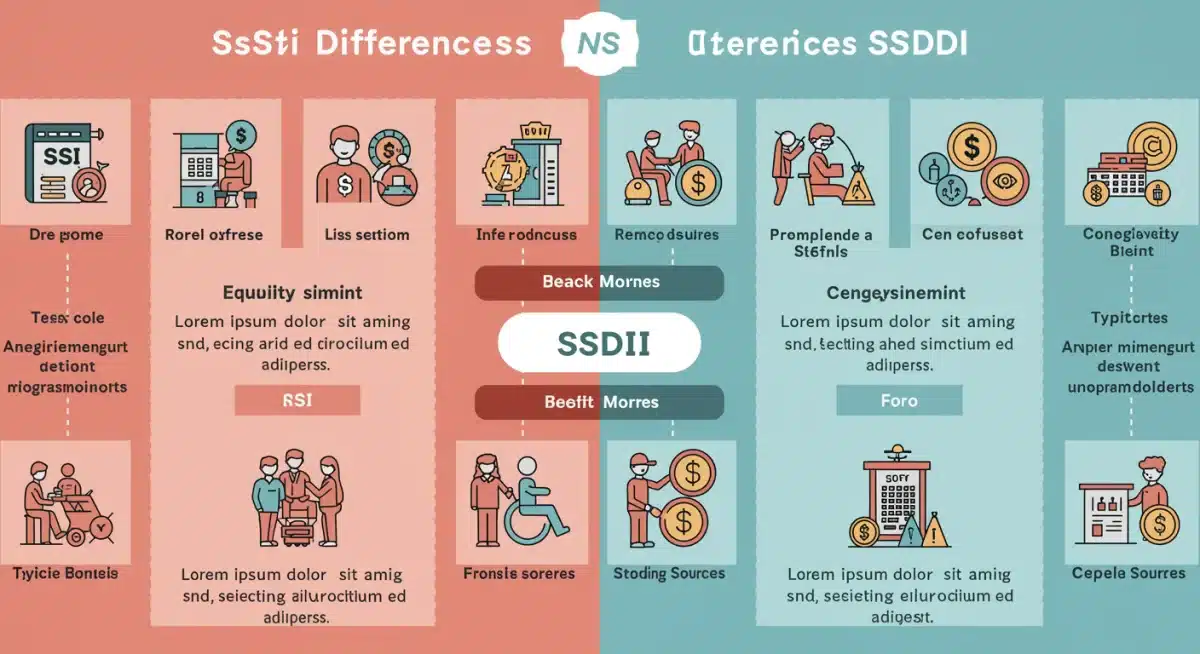
| Eligibility Basis | SSI is needs-based (limited income/resources); SSDI is work-history-based (earned credits). |
| Funding Source | SSI is funded by general tax revenues; SSDI by Social Security taxes. |
| Benefit Amount | SSI has a federal maximum, reduced by other income; SSDI varies by lifetime earnings. |
| Family Benefits | SSDI may provide benefits to family members; SSI does not. |
Frequently Asked Questions About Disability Benefits
Yes, it is possible to receive both SSI and SSDI, a situation known as concurrent benefits. This typically occurs if your SSDI benefit amount is very low, and you also meet the strict income and resource limits for SSI. SSI would then supplement your SSDI payment.
The Social Security Administration uses the same medical definition of disability for both programs: the inability to engage in substantial gainful activity due to a severe impairment expected to last at least 12 months or result in death. The difference lies in financial and work history requirements.
For SSI, most forms of income, including wages, pensions, and even in-kind support, will reduce your countable income, thereby lowering your monthly benefit. The SSA has specific formulas to calculate these reductions, but generally, higher income means lower SSI payments.
Yes, for SSDI, there are limits on how much you can earn from work before your benefits are affected. This is called Substantial Gainful Activity (SGA). If your earnings exceed the SGA limit, the SSA may determine you are no longer disabled, and your benefits could stop.
Comprehensive medical documentation is crucial. This includes all relevant medical records, doctor’s notes, hospital reports, laboratory results, imaging scans, and any other evidence that clearly details your disabling condition and its impact on your ability to perform daily activities and work.
Conclusion
Navigating the landscape of disability benefits in the United States requires a clear understanding of the distinctions between SSI and SSDI. As we’ve explored, while both programs aim to provide crucial financial support to individuals with disabilities, their eligibility criteria, funding sources, and benefit determination methods are fundamentally different. SSI serves as a needs-based safety net, prioritizing those with limited income and resources, while SSDI operates as an insurance program, with benefits earned through years of work and contributions to Social Security taxes. For 2026, staying informed about annual adjustments, understanding the application process, and knowing how other income sources interact with these benefits will be paramount for securing the support you need. Ultimately, making an informed decision about which program, or combination of programs, best suits your circumstances is the first step towards financial stability and peace of mind when facing a disabling condition.